How to Build a Governance & Compliance Framework That Actually Works
For many businesses, governance & compliance feels like a burden. A box to tick before the auditors arrive. A set of rules handed down by regulators that slow things down and add complexity without adding obvious value. But that view is changing, and fast. As data becomes more central to how businesses operate, and as regulations like POPIA and GDPR raise the stakes for getting it wrong, it has moved from the back office to the boardroom.
The businesses that get this right don’t just avoid penalties. They build trust, reduce risk, and create data environments where everyone, from the finance team to executive leadership, can rely on the information they’re working with. This guide walks you through what a strong governance & compliance framework looks like, why it matters, and how to build one that works in practice, not just on paper.
What Is Governance & Compliance?
Governance & compliance are two closely related but distinct concepts. Understanding the difference is important before you can build a framework that addresses both effectively.
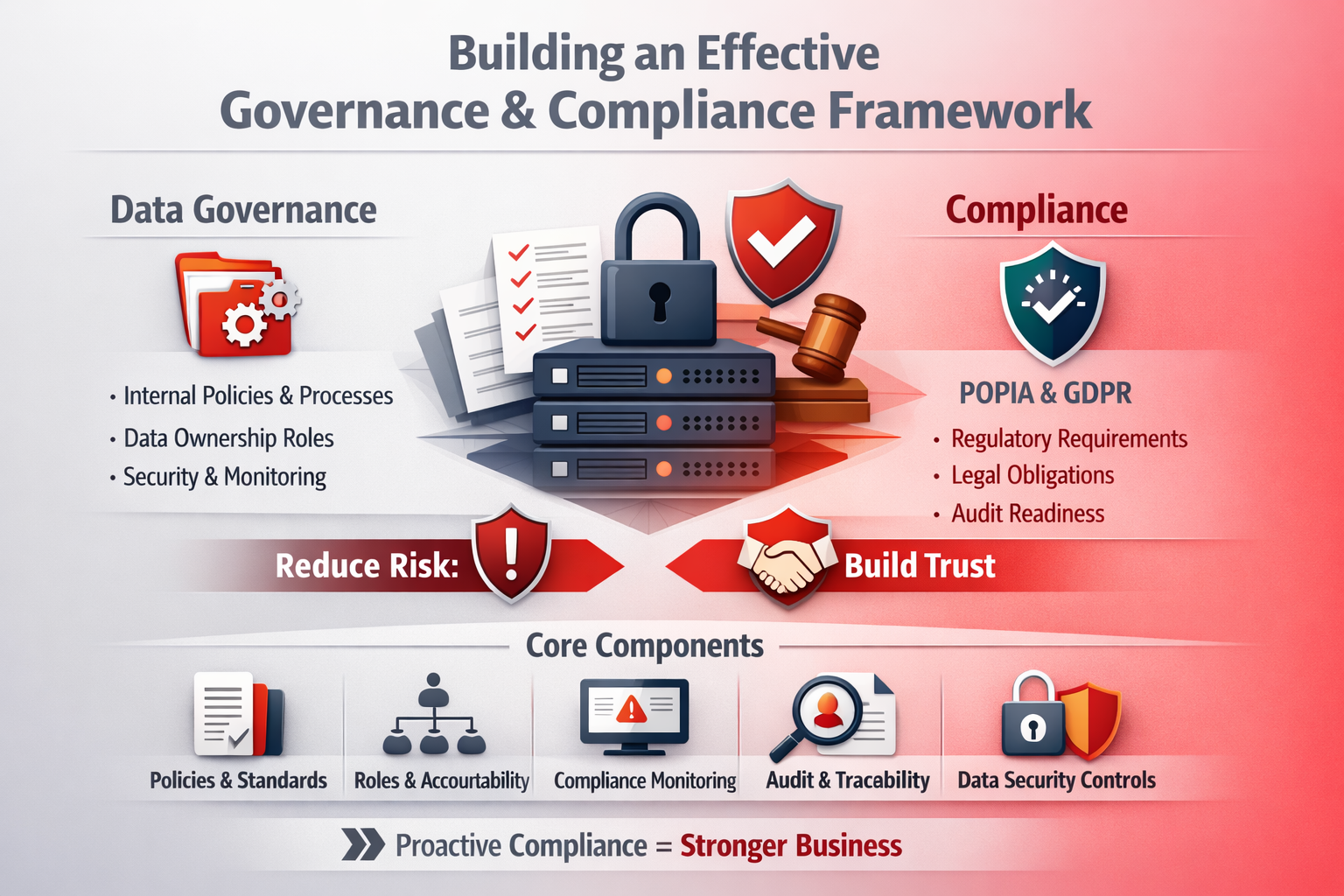
Data governance refers to the internal policies, processes, and standards that determine how data is created, stored, accessed, maintained, and used across your organisation. It answers questions like: who is responsible for data accuracy? How do we handle data that is incorrect or outdated? Who can access sensitive information, and under what circumstances?
Compliance, on the other hand, refers to meeting the external legal and regulatory requirements that apply to your business and its data. In South Africa, this includes the Protection of Personal Information Act, or POPIA. For businesses operating internationally or handling data from European citizens, it also includes GDPR. Depending on your industry, there may be additional sector-specific regulations to meet as well.
A strong framework addresses both. It builds the internal structures that make compliance achievable, and it ensures that meeting regulatory requirements is a natural outcome of how your business manages its data, not a last-minute scramble before an audit.
Why Governance & Compliance Can’t Be an Afterthought
One of the most common mistakes businesses make is treating governance & compliance as something to address reactively. A new regulation comes into effect, and the business scrambles to catch up. A data breach occurs, and suddenly, everyone is trying to figure out what went wrong and who is responsible. By that point, the damage (financial, reputational, and operational) is already done.
Proactive compliance and risk management changes this dynamic entirely. When they are embedded into your data processes from the start, your business is always in a position of readiness. Audits become routine rather than stressful. Regulatory changes can be absorbed without disruption. And data breaches become far less likely because the controls are already in place.
There is also a competitive dimension to this. Businesses that can demonstrate strong governance & compliance build greater trust with their customers, partners, and investors. In an environment where data privacy is increasingly top of mind, being able to show that your organisation handles data responsibly is a genuine differentiator.
The Core Components of a Governance & Compliance Framework
A governance & compliance framework is not a single document or a one-time project. It is a living system of policies, processes, tools, and accountabilities that evolve alongside your business and the regulatory landscape. Here are the core components every effective framework needs.
- Data governance policies:
Clear, documented policies that set out how data is to be managed across the organisation. These cover data classification, retention, access controls, and data quality standards. - Roles and accountability:
Every organisation needs defined roles for data ownership and stewardship. Someone needs to be accountable for the accuracy and integrity of each critical data set. Without clear ownership, the policies rarely get enforced consistently. - Policy enforcement mechanisms:
Policies only work if they are enforced. This means putting tools and processes in place that automatically flag violations, restrict access where necessary, and create an auditable record of who did what with which data and when. - Compliance monitoring:
Effective compliance and risk management requires ongoing monitoring, not just periodic reviews. Your framework should include tools that track compliance status in real time and alert the right people when something needs attention. - Auditing and traceability:
A strong governance & compliance framework maintains a clear, traceable record of how data has been used, who has accessed it, and what changes have been made. This is essential both for internal accountability and for demonstrating compliance to regulators. - Data security controls: Encryption, role-based access, and activity logging are not optional extras. They are foundational elements of any framework that takes data protection seriously.
Compliance and Risk Management: Two Sides of the Same Coin
Compliance and risk management are deeply connected. Compliance tells you what the rules are. Risk management tells you what happens if those rules are not followed and, more importantly, helps you put the right controls in place to prevent that from happening.
Effective management starts with understanding what your risks actually are. This means identifying the data your organisation holds, categorising it by sensitivity, mapping where it flows across systems and departments, and assessing the potential impact of a breach or non-compliance event for each category.
From there, it is about putting proportionate controls in place. Not every piece of data requires the same level of protection. A risk-based approach means your most sensitive data gets the strongest controls, while lower-risk data is managed efficiently without unnecessary overhead.
This is exactly the approach that a well-designed governance & compliance framework enables. By embedding risk thinking into your data governance policies, you create a system where compliance and risk management reinforce each other, rather than operating as separate, disconnected processes.
POPIA, GDPR, and What They Mean for Your Business
For businesses in South Africa, POPIA sets out clear requirements for how personal information must be handled. It applies to any organisation that processes personal data, which in practice means almost every business operating today. Non-compliance can result in significant fines, reputational damage, and, in serious cases, criminal liability.
GDPR applies to any business that processes the personal data of individuals in the European Union, regardless of where the business itself is based. For South African businesses with international clients or operations, this is an important consideration that is sometimes overlooked.
Both regulations share common principles: data must be collected for a specific purpose, stored securely, kept only for as long as necessary, and individuals must have rights over their own information. A governance & compliance framework built around these principles will not only meet the requirements of both POPIA and GDPR but will be well positioned to adapt to future regulatory changes.
The key is not to treat POPIA and GDPR as checklists to be completed but as frameworks that reflect good data practice. When they are embedded in how your business operates, meeting these requirements becomes a natural outcome rather than a separate exercise.
How to Build Your Governance & Compliance Framework Step by Step
Building a framework can feel overwhelming, especially if your organisation is starting from a low base. The good news is that you don’t have to get everything right at once. Here is a practical approach to getting started.
- Assess where you are now:
Before you can build a framework, you need to understand your current state. What data does your organisation hold? Where does it live? Who has access to it? What policies, if any, are currently in place? An honest assessment gives you a clear picture of the gaps you need to address. - Define your goals:
What does good look like for your organisation? This will depend on your industry, the regulations you need to comply with, and the specific data risks your business faces. Setting clear goals gives your framework direction and makes it easier to measure progress. - Build your policies and standards:
Document the rules that will govern how data is managed in your organisation. These should be practical and specific, not vague aspirations. Every policy should be clear enough that anyone in the organisation can understand what is expected of them. - Assign ownership and accountability:
Identify who is responsible for each data set and each governance & compliance policy. Without clear ownership, even the best framework will struggle to be enforced consistently. - Implement tools and processes:
Put the technical controls in place that enforce your policies. This includes access management, data quality monitoring, audit logging, and compliance and risk management reporting tools. - Review and improve continuously:
Your framework is never truly finished. Regulations change, your business evolves, and new risks emerge. Build in regular reviews to make sure your framework stays relevant and effective over time.
Common Mistakes to Avoid
Even organisations with the best intentions can undermine their efforts by falling into common traps. Here are the ones to watch out for.
- Treating compliance as a one-time project. Governance & compliance is an ongoing commitment, not a project with an end date. Organisations that treat it as a tick-box exercise tend to find themselves back at square one every time a new regulation arrives or an audit is announced.
- Keeping governance in the IT department. Data governance touches every part of the business. When it sits solely with the IT team, it rarely gets the cross-functional buy-in it needs to be effective.
- Writing policies nobody reads. A compliance framework is only as good as its adoption. If your policies are buried in a shared drive and nobody knows they exist, they are not doing their job. Communication, training, and enforcement are just as important as the policies themselves.
- Underestimating compliance and risk management. Many organisations focus on meeting the minimum requirements of a regulation without thinking about the underlying risks those requirements are designed to address. Effective management means understanding the ‘why’ behind the rules, not just the rules themselves.
Final Thoughts
Building a governance & compliance framework that actually works is not about creating a mountain of documentation or adding layers of bureaucracy to your organisation. It is about creating clarity on who is responsible for your data, how it should be handled, and what the consequences are when things go wrong.
When they are embedded in how your business operates, they stop feeling like constraints and become a foundation. One that makes your data more trustworthy, your operations more efficient, and your organisation more resilient in the face of regulatory change.
At Agilus, our governance & compliance services help organisations build exactly this kind of foundation. From creating data governance frameworks and enforcing policies to managing compliance and risk management across POPIA, GDPR, and other regulations, we work with you to design and implement a framework that protects your data assets and supports your business goals. Get in touch with our team today to find out how we can help.
What is the difference between data governance and compliance?
Data governance involves internal policies for managing data accurately, while compliance focuses on meeting external legal and regulatory rules like POPIA or GDPR.
Why should a business be proactive about data compliance?
Proactive compliance prevents costly data breaches, makes routine audits stress-free, and acts as a competitive differentiator by building trust with customers.
What are the core components of a data governance framework?
An effective framework requires documented data policies, clear roles for data ownership, automated policy enforcement, real-time monitoring, and strict security controls.
How do compliance and risk management work together?
Compliance sets the regulatory rules, while risk management identifies the potential business impact of breaking those rules and applies proportionate controls to protect sensitive data.
Do South African businesses need to comply with GDPR?
Yes, if a South African business processes or handles the personal data of European Union citizens, it is required to comply with GDPR alongside local POPIA regulations.
What are the biggest mistakes businesses make with data governance?
Common pitfalls include treating compliance as a one-time project, isolating governance entirely within the IT department, and writing complex policies that employees never read.