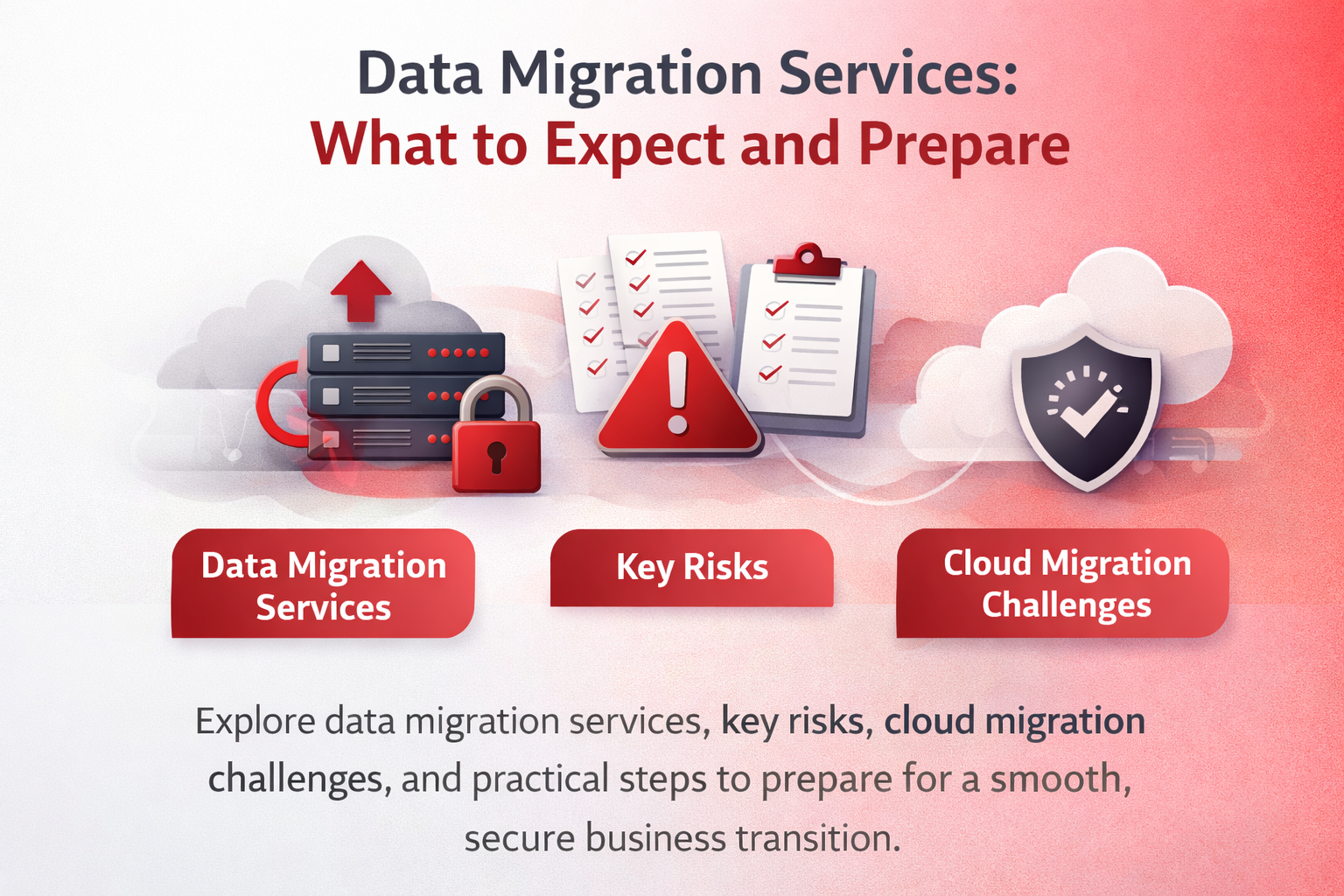
Data Migration Services Explained: What to Expect and How to Prepare
At some point, almost every growing business reaches a crossroads with its data. The systems that worked perfectly well a few years ago start to slow things down. Legacy platforms become harder to maintain, more expensive to run, and less able to support the decisions your business needs to make. When that moment arrives, data migration services become one of the most important investments you can make.
But migration is not something to rush into without understanding what’s involved. Done well, it sets your business up for years of improved performance, better insights, and stronger compliance. Done poorly, it can result in data loss, costly downtime, and a lot of frustration. This guide explains what data migration involves, what the process looks like, and how to prepare your business for a smooth transition.
What Are Data Migration Services?
Data migration services are professional services that manage the process of moving data from one system, platform, or environment to another. This could mean moving from an ageing on-premise server to a modern cloud environment, upgrading an ERP system, consolidating multiple databases into one, or switching between platforms entirely.
What makes these services different from simply copying files from one place to another is the level of care, planning, and validation involved. A professional migration team handles data mapping, cleansing, transformation, testing, and quality assurance at every stage of the process. The goal is not just to move your data but to ensure it arrives in its new environment accurate, complete, and ready to use.
Data migration services cover a wide range of scenarios, including legacy system migrations, cloud data migration, cross-platform database migrations, data warehouse modernisation, ETL pipeline migrations, and application and BI data integration. Each of these comes with its own set of challenges, which is why working with an experienced team makes such a significant difference.
Why Businesses Need Data Migration Services
There are many reasons a business might need these services, but they usually come down to one thing: your current systems are no longer serving your business as well as they should. Here are some of the most common triggers.
- Legacy system limitations
Older systems are often expensive to maintain, difficult to integrate with modern tools, and unable to handle the data volumes a growing business generates. Data migration allows you to move away from these constraints and into a more capable environment. - Cloud adoption
Many businesses are making the shift to cloud platforms for the flexibility, scalability, and cost efficiency they offer. Cloud migration data projects require careful planning to ensure that everything that moves to the cloud arrives intact and that security and compliance requirements are met throughout. - System upgrades and consolidations
Upgrading an ERP, consolidating databases after a merger, or switching to a new analytics platform all require data migration services to ensure continuity and accuracy across the transition. - Digital transformation
As businesses modernise their operations, data migration is often the first and most critical step. Getting your data into the right environment, in the right format, is the foundation on which everything else is built.
The Risks of Getting Migration Wrong
Data migration is one of those tasks that looks simpler than it is. Many businesses underestimate the complexity involved and pay the price later. Understanding the risks is an important part of preparing for a successful migration.
- Data loss and corruption
Without proper validation and checksums, data can be lost or corrupted during transfer. This is particularly damaging when it involves financial records, customer information, or compliance-critical data. - Downtime and disruption
A poorly managed migration can bring business operations to a halt. Professional data migration services use phased approaches and live-sync strategies to keep disruption to an absolute minimum. - Compliance failures
Moving data between environments without the proper security controls can put your business in breach of regulations like GDPR and POPIA. Encryption, role-based access, and activity logging are non-negotiable during any migration. - Legacy system incompatibilities
Older systems often store data in formats that don’t translate directly to modern platforms. Without the right tools and expertise, these incompatibilities can cause significant delays and data integrity issues.
These are exactly the kinds of risks that professional data migration services are designed to manage. With the right team in place, each of these challenges can be anticipated and addressed before they become problems.
The Data Migration Process: Step by Step
A structured approach is what separates a successful migration from a stressful one. Here is what a well-managed data migration services process typically looks like.
- Assessment and planning
Before anything moves, a thorough assessment of your current systems is conducted. This includes identifying all data sources, evaluating data quality, defining the scope and goals of the migration, and mapping out potential risks and compliance requirements. - Design
The target environment is architected, and the best migration approach is selected. This stage also includes building a risk mitigation plan and deciding on the tools and methods that will be used for the transfer. - Execution
Resources are provisioned, and the data transfer begins. Throughout this stage, the migration is monitored closely to ensure everything is moving correctly and securely, with minimal disruption to your operations. - Testing and optimisation
Once the data has been transferred, it is tested for integrity and accuracy. System performance is evaluated, configurations are optimised, and results are documented so there is a clear record of what was done and what was verified. - Deployment and support
The migrated environment is deployed to production, users are trained, and post-migration support is provided to ensure stability and address any issues that arise in the early stages of operation.
Cloud Migration Data: What Makes It Different
Cloud migration data projects have become one of the most common types of migration for businesses today. Moving to platforms like AWS, Microsoft Azure, or Google Cloud offers significant benefits in terms of scalability, cost efficiency, and accessibility. But cloud migration data also comes with its own specific considerations.
Security is a primary concern. Data needs to be encrypted during transfer, and the cloud environment needs to be configured with the right access controls before anything moves. This is especially important for businesses handling sensitive customer data or operating in regulated industries.
Replatforming is another challenge specific to cloud migration data work. On-premise systems often store and structure data in ways that don’t map directly to cloud-native formats. Data transformation is therefore a key part of the process, ensuring that your data not only moves to the cloud but also works optimally in its new environment.
Professional data migration services handle all of this end to end, from replatforming and encryption to validation and post-migration testing, so your business can realise the benefits of the cloud without carrying the risks of a poorly managed transition.
How to Prepare Your Business for a Migration
The success of a migration is not determined solely by what happens during the transfer itself. How well your business prepares beforehand plays an equally important role. Here are the key steps to take before your data migration services begin.
- Audit your current data
Before migrating, you need to know exactly what you have. Conduct a full audit of your data sources, identify duplicates and inconsistencies, and clean up records that are incomplete or out of date. The cleaner your data is going in, the better it will be coming out. - Back everything up
Always back up your source data before the migration begins. This is a non-negotiable step that gives you a fallback if anything unexpected happens during the transfer. - Define your success criteria
Be clear about what a successful migration looks like for your business. What data needs to be validated? What performance benchmarks must the new environment meet? What does a rollback look like if something goes wrong? - Involve the right people
Data migration affects more than just the IT team. Finance, operations, compliance, and any other department that relies on the data being migrated should be involved in planning and testing. - Choose the right data migration services partner
Perhaps most importantly, work with a team that has proven experience in the type of migration you’re undertaking. Ask about their approach, their tools, and their track record. The right partner will ask as many questions as you do.
What to Expect After the Migration
A good data migration services engagement does not end the moment the data has been transferred. The post-migration phase is just as important as everything that came before it.
Expect a period of testing and validation where your team verifies that the data in the new environment matches what was in the source system. This is also when business users get hands-on with the new platform, and any gaps or issues are identified and resolved.
User training is another important part of the post-migration phase. Even the best data migration services in the world won’t deliver their full value if the people using the new system don’t know how to use it effectively. Good partners provide training and support as part of the handover process.
Finally, expect ongoing support for a defined period after go-live. It is normal for small issues to surface in the first few weeks of operating in a new environment. Having your migration partner available to address these quickly makes a significant difference to how smoothly the transition is experienced by your team.
Final Thoughts
Data migration services are one of those things that businesses tend to underestimate until they’re in the middle of one. The complexity is real, the risks are significant, and the stakes are high, because your data underpins everything your business does. But with the right preparation and the right partner, a migration can be one of the most transformative steps your business takes.
Whether you’re moving legacy data to a modern platform, undertaking a cloud migration data project, consolidating databases, or modernising your data warehouse, the key is to approach it with a structured plan, clear goals, and a team that has done it before.
At Agilus, our data migration services are built around one goal: getting your data where it needs to be, accurately, securely, and with minimal disruption to your business. From the initial assessment through to post-migration support, we manage every step of the process so you can focus on what you do best. Contact our team today to schedule a free consultation and find out how we can help.
What is the difference between data migration and just copying files?
Data migration goes beyond simply copying files by actively cleansing, mapping, transforming, and validating data to ensure it functions perfectly in its new environment.
What are the biggest risks of a bad data migration?
Poorly executed migrations can result in irreversible data corruption, expensive operational downtime, and severe regulatory compliance failures (such as GDPR violations).
Will a data migration shut down my daily business operations?
No; professional migration services utilize phased transfers and live-syncing to move your data securely with minimal to zero disruption to your business operations
How should a business prepare for a data migration?
You should prepare by auditing your data to remove duplicates, backing up all source files, and defining clear success criteria with your migration partner.
Why is migrating data to the cloud more complicated?
Cloud migrations require strict transfer encryption and “replatforming” to transform legacy, on-premise data formats into structures compatible with modern cloud environments
What happens immediately after data is migrated?
The post-migration phase focuses on rigorous data validation, system performance testing, user training, and providing support to resolve early operational bugs.
How does Agilus handle data migration services?
Agilus provides end-to-end data migration—from initial assessment to secure transfer and post-go-live support—ensuring your data is moved accurately and securely.
Lorem ipsum dolor sit amet, consectetur adipiscing elit. Ut elit tellus, luctus nec ullamcorper mattis, pulvinar dapibus leo.